

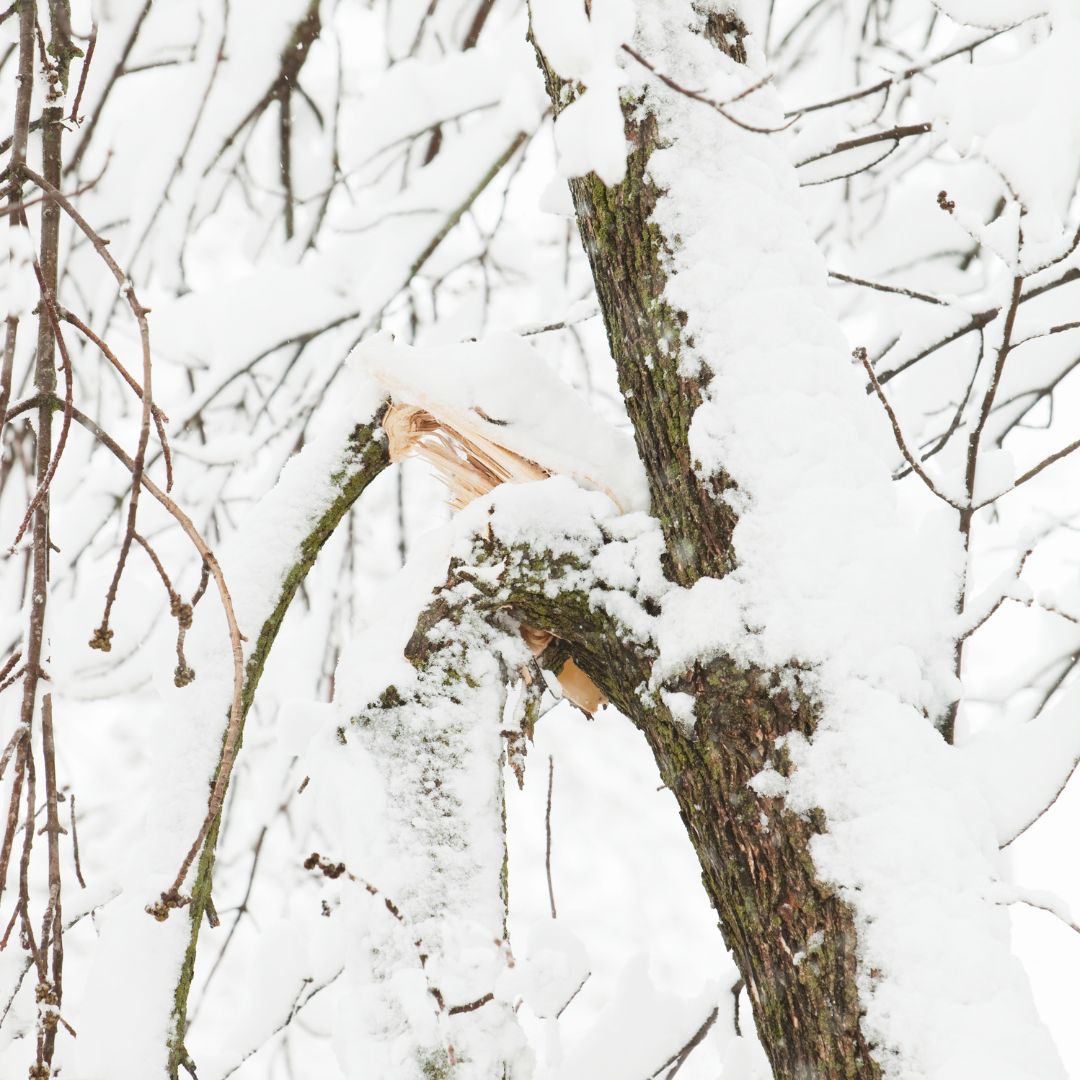
In Colorado, we have a saying: "If you don’t like the weather, wait five minutes." But when a heavy, wet snow hits in late April or May, those five minutes can feel like a lifetime as you watch your prized trees and shrubs bend under the weight. While any snowstorm can be tough on landscape plants, late-season storms are particularly damaging.
Why Late Season Snow Is So Damaging
Why is a May snow so much worse than a January blizzard? It’s all about surface area. In the dead of winter, deciduous trees are dormant and bare; snow mostly falls through the branches to the ground.
However, once the warm spring weather hits, those trees begin to leaf out. When heavy, wet "slush" accumulates on thousands of surface-level leaves, the weight on a single limb can increase by several hundred pounds in a matter of hours. This leads to the characteristic snapping and splitting we see during these late season snow storms.
Damage Prevention
If the snow is still falling and it is safe to be outside, or immediately after it is done snowing, you can help your plants—but be gentle.
- Brush, don’t beat: Use a broom to gently push upward on branches to shed the snow.
- Never pull or hit: No one likes being whacked with a stick, not even trees. Cold wood is brittle. Hitting branches too hard can cause them to snap. We do not recommend grabbing or pulling branches downward as that can also cause further damage. Gentle shaking is the name of the game.
- Bottom-up: Always clear the lower branches first. If you start at the top, the falling snow will overload the already-stressed lower limbs.
Preventative Pruning: For trees five years and older—particularly soft-wood species like Cottonwoods and Pears—regular maintenance is vital. These fast-growing trees benefit from seasonal thinning to eliminate structural weak spots. You should specifically target branches that cross or rub together; in Colorado’s high-wind environment, this friction creates wounds and structural instabilities that often fail under the weight of late-season snow. By proactively pruning cracked or compromised limbs now, you prevent the hazards of falling debris later.
Even with the most diligent pruning and branch shaking, sometimes snow damage is inevitable. Here is what we recommend for damaged trees and shrubs:
Wait & See: Assessing the Damage
Do not make any rash decisions until the snow melts and you can get a full picture of the damage. Luckily with this recent storm, the snow melted quickly. Once the sun is out, assess your trees and shrubs based on these criteria by the Colorado State Forest Service:
- The 50% Rule: If the plant has lost more than half of its branches or crown, it may no longer be able to produce enough energy to survive the year.
- The Main Leader: Is the central upward trunk intact? If the "top" of the tree is snapped, the structure is permanently compromised.
- Wait and See: Colorado trees are resilient. If the damage is aesthetic rather than structural, and there are no safety concerns, give the tree a full growing season to "fill in" before deciding to remove it.
Need help assessing the damage of your newly planted tree or shrub? Email a picture to fossilcreekstore@gmail.com and our nursery team can help! For larger established trees, we recommend contacting a Certified Arborist to asses damage and health.
Proper Pruning & Repair
If you have broken limbs, proper "surgery" is required to prevent disease. We recommend the following:
-
Remove Broken Branches: With clean pruners, remove any broken branches still attached to the tree or shrub. Plants are like humans, they are susceptible to disease. A clean pair of pruners is like a clean scalpel- keep it clean and keep your plant healthy!
- Large branches or any branch that presents a safety concern should be removed by a Certified Arborist.
- Skip the Dressing: We do not recommend using a sealant for any pruning or branch injuries. Research shows that trees heal best when they can "wall off" the wound naturally through exposure to air. In short, let ‘em breathe.
- Don’t Over-Prune: Your plant may look a little raggedy for a bit, but do not go crazy with the pruners. The plant needs its remaining healthy limbs to produce enough energy to recover. The wounds should heal and your plant will eventually return to normal.
Time To Call In The Pros: Hiring A Certified Arborist
While homeowners can handle minor pruning and snow removal on shrubs or small ornamental trees, large trees require a level of expertise that goes beyond a standard landscaping crew or nursery professionals. For significant storm damage, we strongly recommend hiring an ISA Certified Arborist.
Large tree work is statistically one of the most dangerous jobs in the country. Certified Arborists possess the specialized rigging, training, climbing gear, high-reaching lifts, and insurance coverage necessary to remove heavy branches safely. Attempting to use a chainsaw on a ladder is a recipe for disaster; professionals manage the physics of falling wood so it doesn't land on your roof—or you.
A Certified Arborist is trained to identify and asses a tree’s health- including hidden rot or decay, disease, pest infestation, and much more. They don’t just look at the broken branch; they look at the entire biological system.
The Road to Recovery
Once the pruning is done, the best thing you can do is water. Colorado's dry air can quickly dehydrate a stressed tree.
Learn more with the Colorado State Forest Service
Safety Note: If a branch is high in the air, near power lines, or requires a chainsaw or ladder, stop. Contact an ISA Certified Arborist. Professional help is much cheaper than a trip to the emergency room.


